

Department position regarding generative AI in design education
Design is grounded in human curiosity, observation, imagination, judgment, empathy, material engagement, and responsibility. While generative AI (genAI) may assist these activities, it cannot assume the designer’s responsibility or replace the student’s lived experience, disciplinary learning, or the ability to explain and defend design decisions.
TEDU Industrial Design approaches genAI neither as a replacement for human thinking nor as an automatic indication of academic misconduct. We use and teach AI only where it supports clearly identified learning goals, while preserving students’ creative agency, intellectual development, and authorship. We will continually review our practices as technologies, educational needs, professional standards, and institutional and legal requirements develop.
Our department commits to:
- Encourage critical AI literacy: In addition to practical skills to use AI ethically and effectively in their work, students should learn the impact and outcomes of these systems, such as hallucinations, bias, privacy, intellectual property rights, and data limitations.
- Protection of learning and design thinking: AI may be used only where its role is compatible with or supports the learning outcomes. It should not be used to bypass the knowledge, skills, reflection, experimentation, or making that design education intends to cultivate. Students must have opportunities to practise manual observation, research, writing, drawing, modelling, problem solving, material experimentation, critique, and decision-making.
- Preserve creative agency: AI must serve as an assistive system rather than replacing human creativity. Students remain responsible for framing the problem, validating information, establishing design criteria, creating and selecting alternatives, detailing, and explaining their design decisions.
- Clear communication and transparent use: Every student should receive clear and timely information about whether and how AI may be used in each course and assignment. Where AI is used, human review, transparency, verification, attribution, and respect for intellectual property remain mandatory. Instructors will identify course or assignment-specific genAI use, permitted and prohibited tasks, and required disclosure expectations. Students must be able to distinguish what they contributed from what the system suggested or generated.
- Maintain accountability and oversight: AI systems cannot accept academic, professional, ethical, or legal responsibility. The person submitting, publishing, or approving the material remains accountable for its accuracy, appropriateness, originality, safety, and compliance with requirements. As such, students are obliged to oversee the genAI output, and bear the responsibility for their submission in its entirety.
- Respect privacy and confidentiality: Information submitted to AI systems may risk privacy of individuals and confidentiality requirements of institutions. Since TED University currently does not offer institutionally approved, secure AI systems, students and instructors must pay attention not to enter personal, sensitive, confidential, and unpublished data into AI systems. This includes student records, user research data with identifiable personal details, confidential documents of external project stakeholders (e.g. companies, NGOs), and unpublished teaching materials that instructors label as intellectual property.
- Consider accessibility and support: AI use requirements in coursework should not give an advantage to students who can afford premium tools. Whenever possible, reasonable alternatives should be permitted to use for the given task. Students and instructors should seek institutional guidance and training when needed.
- Compliance with institutional policies: Instructors and students must comply with the relevant university policies and regulations, such as Ethical and Responsible Use of Generative Artificial Intelligence Policy, Clarification Text on Personal Data Processing, and Academic Integrity Statement for Students.
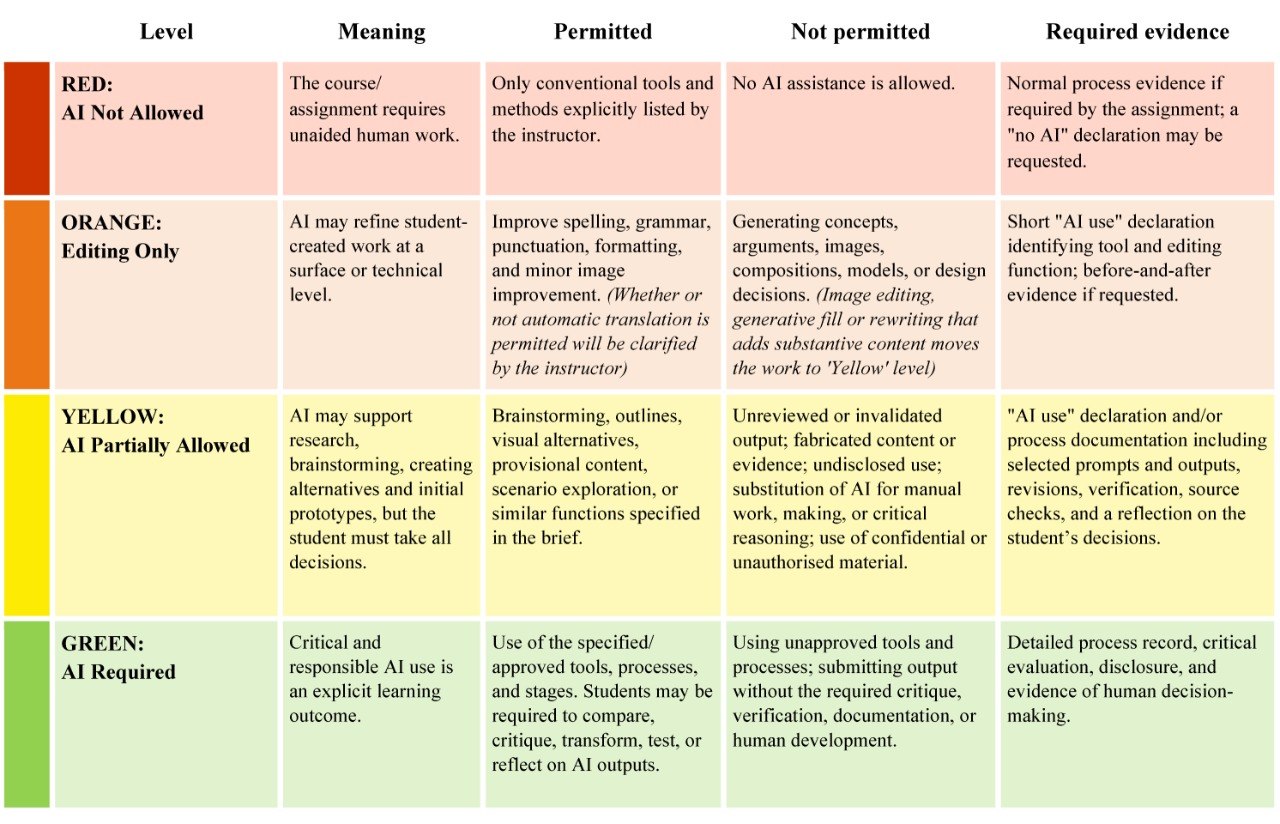
Four-level AI use framework
The four-level system is an instructional and assessment communication tool, based on to what extent and for what purposes genAI use is allowed for a given task. A course may set a general level, but an assignment may establish a different level. A single assignment may also assign different levels to different stages. (e.g. 'Red' for user research, 'Yellow' for ideation, and 'Orange' for final presentation).
Rules applying to all levels
- The instructor must publish the level, instructions and restrictions before students begin the relevant work.
- Students must not be rewarded on the basis of using "more or less AI", or the performance of a commercial system’s output.
- Where no level is stated, students must seek written clarification before using genAI in assessed work.
- When the instructor permits specific uses of AI, students are not automatically required to use AI unless explicitly stated otherwise.
- Data privacy, confidentiality, intellectual-property, and consent rules apply at all levels.
Student responsibilities and liabilities
1. Understand the rules and what is allowed
The course instructor announces course and assignment-specific AI use permits and requirements in the syllabus and briefs. Students must read the syllabus and each assignment brief and determine:
- The required AI level for the task;
- Which tools and functions are permitted;
- Which stages of the task may or may not involve AI;
- What process records and disclosures are required.
2. Disclose AI use and keep records
Students remain responsible for doing the intellectual and creative work required by the learning outcomes. They must not allow AI to replace their own judgment, ability, observation, reflection, or making. Students should be able to explain and disclose with evidence:
- What problem they addressed;
- What they learned;
- Which decisions they made;
- Which AI suggestions they accepted or rejected;
- Why the final work is appropriate;
- How they verified the work;
- How the work changed through human intervention.
3. Always verify AI outputs
Students are responsible for checking every AI-assisted element used in a submission. This includes references, quotations, data, claims, facts, translations, and visual representations. Statements such as “AI produced it” or "I couldn't manage to get AI to do it" do not remove responsibility.
4. Respect privacy, confidentiality and intellectual properties
Students must check that they are entitled to use input material and that the output can lawfully and ethically be incorporated into the work. They must not upload protected data, peers' or instructors' intellectual work, external project partners' confidential information, unpublished material, user research data without anonymization, or identifiable images and recordings to AI systems. Where a group project involves AI, the group must agree on the tool and data practices. One student must not upload shared material without informing the other members.
5. Assume academic responsibility and possible consequences
Using AI contrary to an instructor’s stated conditions may constitute an academic integrity violation under TEDU policy. TEDU’s Academic Integrity Statement already treats unauthorised use of educational computer tools, non-existent sources, fabricated data, copying, insufficient attribution, outsourcing, and unfair advantage as relevant forms of misconduct. Instructors reserve the right to inspect the submitted work for potential misconduct, use additional assessment methods such as oral or written examination, ask for detailed records of AI use and how it contributed to the submission, and call for a disciplinary proceeding.
Ethical AI Use Checklist for Students
Did you check:
- What level of AI use applies to this course or assignment? (Do not assume that permission in one assignment applies to another.)
- What are you trying to learn or achieve? Is AI helping you learn, or performing the part you are supposed to practise yourself in the first place?
- Which decisions must remain yours? Can you explain the work without relying on the AI conversation?
- Does the prompt or uploaded file contain personal, confidential, institutional, or unpublished information? Do you own or have permission to upload and use the material?
- How will you verify claims, sources, and technical information?
- How will you record and disclose the AI contribution? Have you retained the evidence required by the brief?